
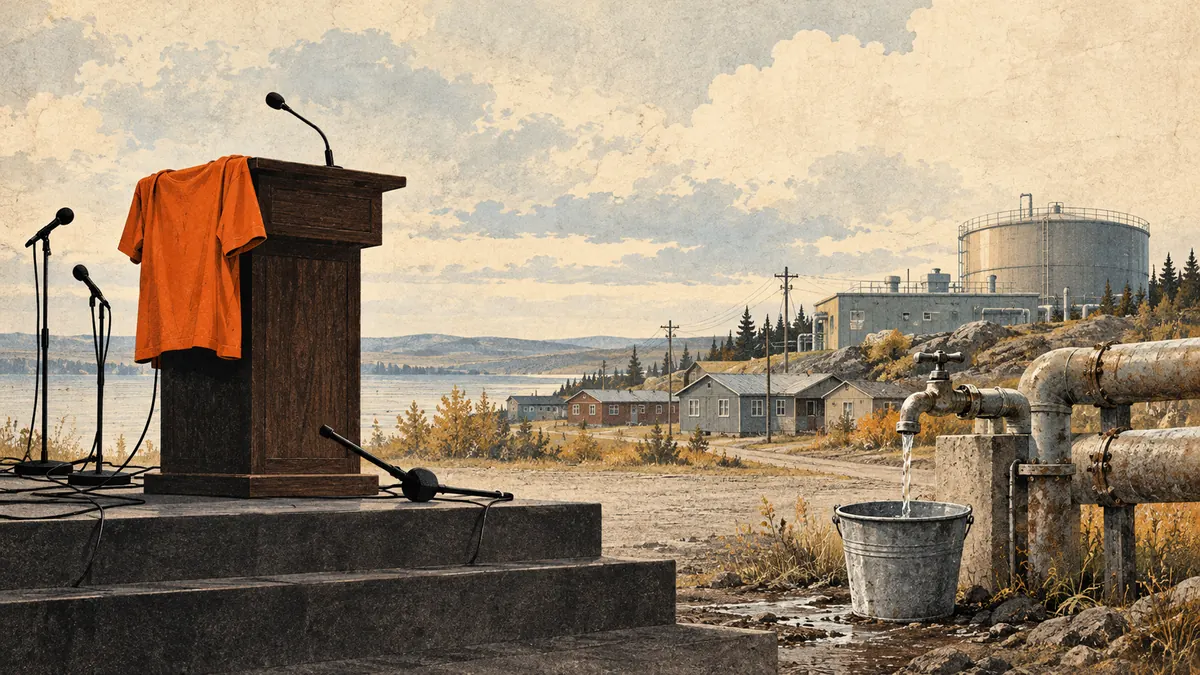
An Orange Shirt Is Not a Clean Water System
Ottawa can stage a reconciliation photograph. Can it deliver reliable water and habitable homes? Judge the promises by the services, spending and results that follow.
Sources & supporting records
- Tk̓emlúps te Secwépemc: investigation update, February 17, 2026
Primary update. Describes potential burials, investigation methods, areas ruled out and possible preservation or excavation.
- NCTR: additional names verified for the memorial register, September 2025
Documentary research and names in a national register; distinct from physical findings at Kamloops.
- Crown-Indigenous Relations: missing children and burial information
Funding commitments and agreement totals, with dates and program scope. Not an audited total of spending at Kamloops.
- Federal government: August 10, 2021 funding announcement
The approximately $320-million package covers multiple purposes; do not add overlapping budget figures as separate costs.
- Orange Shirt Society: frequently asked questions
The society describes the 2013 origin and distinguishes Orange Shirt Day from the federal day established in 2021.
- PMO archived photo gallery: Cowessess visit, July 6, 2021
Primary photo record: location, date, teddy bear and credit. This is Cowessess, not Kamloops.
- Indigenous Services Canada: September 10, 2026 water-advisory snapshot
Dated count for public systems within the department’s reporting scope; not a count of all water problems.
- Auditor General: Housing in First Nations Communities, March 19, 2024
Historical audit findings and funding prioritization, not an October 2026 census.
- MBC Radio: Chief Delorme’s June 24, 2021 statements about Cowessess
Contemporaneous reporting of the chief’s distinction between unmarked graves and a mass grave, and possible adult and child burials.
Canada has become remarkably good at photographing reconciliation. Politicians kneel, corporations issue statements and institutions dress themselves in orange. Meanwhile, families in First Nations communities still need safe water, decent housing and public services that work. The performance is visible. The results deserve a much harder look.
The Kamloops story illustrates why evidence must come before political certainty. Nearly five years after the 2021 announcement, Tk̓emlúps te Secwépemc’s February 17, 2026 update described signatures resembling burials, areas ruled out and possible future excavation. It did not announce excavated remains or the forensic identification of 215 children. It also said utility lines and clay tiles had been ruled out in overlapping areas of interest. That is the published position: possible burials, not 215 recovered bodies. [1]
Those distinctions were too often lost in the public conversation. Radar can identify targets for investigation; it does not supply names, ages or causes of death. Asking what was physically confirmed is reasonable. Officials who use the moral weight of dead children to command public attention owe the public equally clear explanations of what the evidence establishes. The absence of excavation does not prove there are no burials. It does mean physical recovery should not be implied when it has not been demonstrated.
Consider the photograph of Justin Trudeau kneeling and placing a teddy bear beside a small flag and solar light. The Prime Minister’s Office identifies the visit as Cowessess, Saskatchewan, on July 6, 2021. It is not a photograph of the Kamloops investigation. At Cowessess, Chief Cadmus Delorme had distinguished unmarked graves from a mass grave and said adults as well as children might be buried there. The identity and history of each burial mattered. [6][9]
As political communication, the image deserves scrutiny. A prime minister kneeling with a teddy bear gives an unsettled story the appearance of official certainty. The photograph can communicate the emotional conclusion more forcefully than any qualification attached to it. In our view, Trudeau added his office’s authority to that atmosphere without the image doing anything to establish whose remains lay at that particular marker. Compassion does not require abandoning precision. Public leadership should make the distinction clearer.
The gesture did not identify a child, verify a cause of death or repair a water system. Those are the achievements that require evidence. The image presented a leader visibly grieving while the harder questions remained outside the frame. Canadians are entitled to judge that imbalance without being told that scrutiny itself is disrespectful.
The spending needs the same discipline. Crown-Indigenous Relations reports $323.1 million invested in implementing Calls to Action 74 to 76 and $254.9 million covered by 162 agreements as of September 15, 2025. The program includes research, locating and documenting burial sites, commemoration and possible repatriation. These are program figures, not a verified excavation bill for Kamloops or an audited total of cash spent. [3]
The separate $320 million announcement in August 2021 covered several purposes, including $83 million for search and commemoration, $100.1 million for former school buildings and replacement facilities, and $107.3 million for support services. Those categories need separate accounting, with overlapping announcements counted only once. The proper demand is for recipients, actual expenditures, administrative costs and deliverables. If public money bought results, show them. If it did not, explain why. [4]
There are results we can measure. Indigenous Services Canada’s September 10, 2026 snapshot listed 38 long-term drinking-water advisories in 36 communities within its public-system reporting scope. It also recorded 158 advisories lifted since November 2015. That progress should be acknowledged, but the remaining failures deserve more sustained attention than an annual photograph. Reliable water requires trained operators, maintenance and operating budgets after the construction announcement has disappeared from the news. [7]
Housing tells a similar story. The Auditor General’s March 2024 report found little progress, with about 80 per cent of identified housing needs still unmet seven years before the 2030 target. Communities with the worst housing conditions were not consistently receiving priority. These are dated audit findings, not an October 2026 count. They demand an updated accounting of what has changed and who is answerable for the gaps. [8]
Historical deaths and abuse do not have to be denied to challenge today’s political narrative. The National Centre for Truth and Reconciliation’s documentary register records children who died in the residential-school system. That history does not settle every claim about a particular radar target, and it does not excuse present-day failures. Respect for those affected should mean insisting on accurate claims and competent delivery, rather than protecting officials from awkward questions. [2]
White Canadians living today are not personally guilty of an earlier government’s actions because of their ancestry. Accountability belongs with the institutions, decisions and people responsible. Citizens can support fixing current failures without accepting guilt assigned by skin colour. Racial finger-pointing makes an easy political spectacle and a poor foundation for practical cooperation.
Indigenous communities should not be reduced to permanent symbols of victimhood either. Their residents have ambitions, disagreements and the right to expect competent services and meaningful control over their futures. Treating their hardship as material for someone else’s moral performance does not strengthen that agency. It rewards the people who can display concern most convincingly.
Wearing orange can express sincere concern. It becomes superficial when institutions treat the gesture as the accomplishment. The test is what follows: habitable homes, reliable water, access to treatment, functioning schools, transparent spending and projects completed. Publish the evidence. Correct the exaggerations. Account for the money. An orange shirt is not a clean water system, and a photograph of a kneeling prime minister is not a substitute for either truth or results.