
Selkirk Copper release their PEA the other day and I immediately sent emails regarding concerns. Being this is my largest holding in my portfolio, I needed answers.
Today those concerns were addressed in an update.
$SCMI.V / $SKRKF
Quite a bit has happened since the Minto PEA was released, and management has now addressed one of the biggest concerns I had with the study.
When the PEA came out on September 22, the headline numbers looked strong: a 13-year mine life, C$494 million after-tax NPV7, 47.8% after-tax IRR, 1.9-year payback and C$185.9 million initial capital requirement.
Despite those numbers, the stock was hit hard.
When I went through the release in more detail, something immediately bothered me. The C$185.9 million headline capital number did not include several expenditures Selkirk expects to incur before its formal CAPEX period begins on July 1, 2027.
Those excluded pre-CAPEX items included dewatering and rehabilitating the underground mine, re-servicing the workings, ongoing water treatment, equipment deposits, generator refurbishment and regular site care and maintenance. Selkirk's PEA explicitly said those costs were excluded from the economic analysis and treated as sunk costs.
From my perspective as a shareholder, they aren't sunk costs yet if Selkirk still has to spend the money.
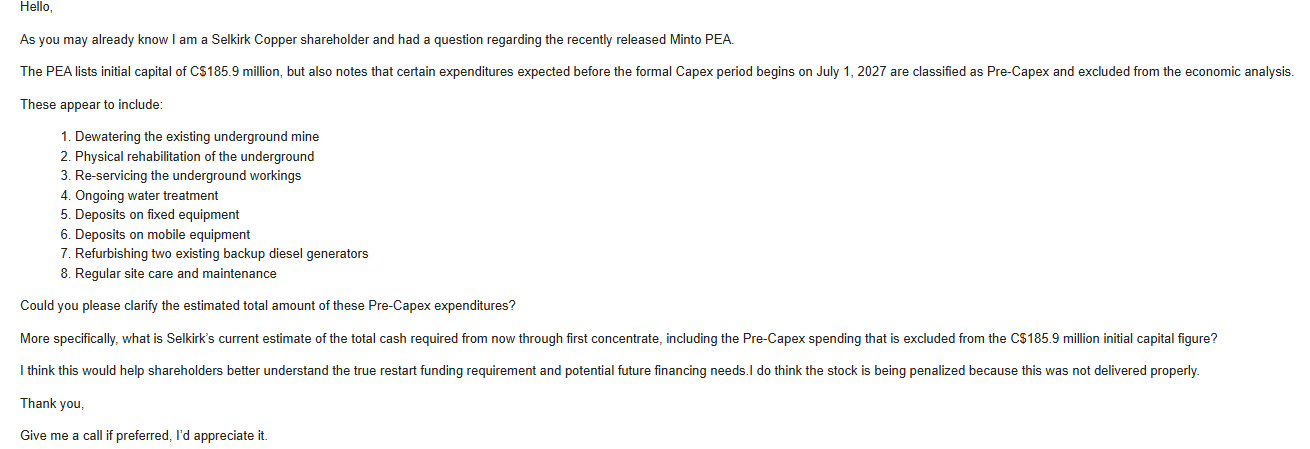
That was the issue I emailed management about.
What I Asked Selkirk
The two main questions in my email were very simple:
“Could you please clarify the estimated total amount of these Pre-Capex expenditures?”
And more importantly:
“What is Selkirk's current estimate of the total cash required from now through first concentrate, including the Pre-Capex spending that is excluded from the C$185.9 million initial capital figure?”
I also told management directly that I thought the stock was being penalized because this wasn't communicated properly.
The VP responded to me and said he would give me a call when he had some time.
Then today, only two days after the PEA, Selkirk sponsored a new Global Stocks News article that directly addressed the exact issue I had raised.
I obviously can't prove my email alone caused management to put this clarification out. They may have been getting similar questions from other shareholders as well. But I do think my email helped put the issue directly in front of management, and the timing is difficult to ignore.
Most importantly, I got the main answer I was looking for.
Question #1: How Much Are the Missing Pre-CAPEX Costs?
Answer: approximately C$20 million.
Scott Fulton, Selkirk's VP of Engineering, specifically addressed the issue in today's article:
“Certain pre-capex costs are not included in the PEA economic model. We estimate these costs to be about $20 million.”
That number should have been in the original PEA announcement, in my opinion.
When the PEA simply said these costs were excluded, shareholders had no idea whether we were talking about C$10 million, C$20 million, C$50 million or considerably more.
Now we know.
And C$20 million is manageable in relation to the overall project.
Instead of looking at the restart as simply:
C$185.9M initial CAPEX
I think the more realistic working number is approximately:
C$185.9M initial CAPEX
+ ~C$20M pre-CAPEX
= ~C$205.9M
That is a much clearer picture.
Question #2: What Is the Actual Cash Requirement to First Concentrate?
This one was mostly answered, but not completely.
We can now reasonably say that the currently identified capital requirement is around C$206 million when the approximately C$20 million of excluded pre-CAPEX spending is added to the C$185.9 million initial CAPEX.
But management still hasn't explicitly said:
“Selkirk needs exactly C$X in additional cash from today through first concentrate.”
There is an important distinction there.
We still need clarification on whether the approximately C$20 million represents the entire pre-CAPEX program, including money already spent, or whether it represents approximately C$20 million that still needs to be spent going forward.
I also want to know whether that number includes all feasibility, permitting and related development expenditures before July 2027.
So I would say management has answered most, but not all, of my second question.
The Biggest Concern Is Much Smaller Now
This changes how I look at the PEA.
Before today's clarification, the excluded pre-CAPEX costs were essentially an unknown number sitting outside the C$185.9 million headline.
That bothered me.
If those costs had turned out to be another C$50 million or C$75 million, suddenly the capital required to restart Minto would look considerably different from what investors were initially presented.
At approximately C$20 million, that concern comes down substantially.
It doesn't disappear completely, but it no longer looks like a potential hole in the economics.
I Also Think Phase 2 Was Undersold
The other thing I raised with management is Phase 2 drilling.
Selkirk's 50,000-metre Phase 2 drill program is now 98% complete, and none of it is included in the PEA economics.
I think this deserved much more emphasis when the PEA was released.
The current Minto resource already contains 47.8 million tonnes of Measured and Indicated material containing 940 million pounds of copper, yet the PEA mine plan only uses approximately 18.4 million tonnes for its initial 13-year mine life.
Then we have another nearly 50,000 metres of drilling sitting completely outside that resource and mine plan.
Personally, I would have preferred Selkirk delay the PEA long enough to incorporate Phase 2.
I understand why they didn't. They had committed to delivering the PEA in Q3, and the updated Phase 2 resource is now planned for Q1 2027, with the results feeding into the Feasibility Study beginning in Q4 2026.
But I think the market looked at the PEA and saw a 13-year mine when the actual longer-term potential could be considerably larger.
Interestingly, today's article puts much more emphasis on this.
Scott Fulton specifically pointed out that Phase 2 is completely excluded and said a 13-year mine plan is a good start, with potential north and south of Minto that he believes could eventually support a much longer-lived operation.
That is exactly the type of message I thought should have been emphasized when the PEA was released.
So Did Management Respond to the Market Reaction?
That's how I read today's article.
The article is sponsored content. Global Stocks News states that it was disseminated on behalf of Selkirk Copper, so this wasn't an independent analyst suddenly deciding to defend the PEA.
Selkirk wanted this information communicated.
Two days after the PEA and the sharp selloff, the company is now emphasizing:
Pre-CAPEX is only approximately C$20 million.
The PEA cost estimates were built from first principles.
The company considers the study comprehensive.
Phase 2's nearly 50,000 metres are completely excluded.
The 13-year mine life is viewed as a starting point rather than the end of Minto's potential.
That looks to me like management trying to calm some of the concerns that surfaced immediately after the PEA.
Again, I won't claim my email single-handedly triggered the article. But I sent management these exact concerns, specifically told them I thought poor communication around the excluded costs was hurting the stock, got a response from the VP offering to speak with me, and then shortly afterward Selkirk put out a sponsored article addressing essentially the exact question I had asked.
I do believe my concerns were heard.
What Is Still Unanswered?
There are still a few things I want to discuss with management when I get that call.
First, is the C$20 million the total pre-CAPEX budget, or the amount still remaining to be spent?
Second, does it include Feasibility Study, permitting and related corporate development costs, or are those separate?
Third, what will Yukon ultimately require for reclamation or financial assurance before a restart?
And probably most important for shareholders, how does Selkirk plan to finance the roughly C$206 million restart requirement?
The PEA actually gives Selkirk some interesting options here. The old concentrate offtake agreement and precious-metals stream were eliminated through the bankruptcy process, leaving the project unencumbered. Selkirk says it intends to investigate concentrate-linked prepayments and other offtake financing structures that could cover a portion of the upfront capital without relying entirely on new equity.
That's something I'll be paying very close attention to.
I've also made it clear to management that if there is another equity financing, I'd be interested in participating again.
Where I Stand After Today's Clarification
I feel considerably better about the PEA today than I did immediately after reading it.
The economics didn't change.
The missing information did.
The difference between an unknown pre-CAPEX requirement and approximately C$20 million is significant.
We now have roughly C$206 million of identified pre-production capital supporting a project with a C$494 million after-tax NPV at the planning case, a 47.8% IRR, a 1.9-year payback, substantial existing infrastructure, and almost 50,000 metres of additional Phase 2 drilling that hasn't even entered the resource or mine plan yet.
I still think Selkirk mishandled the communication around the PEA. The C$20 million number should have been there from day one, and I think Phase 2 should have been highlighted much more aggressively.
But management appears to have recognized that investors had questions, and they moved quickly to provide some answers.
In my case, they answered the biggest question I sent them.
I'll update everyone again after I speak directly with the VP and hopefully get clarity on the remaining funding and financing questions.
Disclosure: I own shares of Selkirk Copper and have participated in a previous Selkirk financing. I have also told management I would be interested in participating in a future financing. This is my own analysis and is not financial advice.