
The CEO interview and our conversation
In the Resource Talks interview below, the share-price discussion begins around 32:23. Shortly afterward, Kevin Keough refers to a conversation with a blogger about Oreterra’s selling pressure. That blogger is me, Ryan David, and this is the article that captures the conversation he is referring to. The player starts at 32:23 so you can hear the question and his answer in context.
I have been in contact with Kevin Keough, CEO of Oreterra Metals, trying to get a better handle on the recent selling pressure.
The past couple of weeks have been a reminder of what junior mining stocks are: extremely volatile vehicles where the path to a multibagger is almost never a straight line. We have seen a broad pullback across mining equities, with quality juniors getting hit alongside weaker names. That can be uncomfortable, but it is also normal in this sector. If you are looking for 5x, 10x or greater returns, you have to accept that individual positions can fall 50% along the way. Some will fail altogether. A stock can fall 40% or 50% without the exploration thesis deteriorating by the same amount. Liquidity dries up, financing paper becomes free-trading, traders take profits, and warrants change the economics of selling. That brings me to Oreterra Metals (OTMC.V).
Oreterra: separating the stock chart from the geology
Oreterra has pulled back significantly from its highs. I was surprised by how much volume came into the stock around the drill news, only for it to give back the entire move and then some. This industry is all about speculation, but that does not mean simply buying a story and hoping. It means digging through financials, understanding the share structure and having conversations with management. Those are things I have been doing with this name. My original suspicion was that Oreterra had created a setup where a considerable amount of profitable paper suddenly had the liquidity to be sold.
After speaking with management, I have confirmation of the basic mechanics behind that theory, along with a much clearer picture of who has sold and who has not. Romios, Oreterra’s predecessor, entered the restructuring with a substantial amount of legacy paper. In October 2025, roughly $968,000 of debt was settled through approximately 25.6 million pre-consolidation shares issued at $0.02. Following the 1-for-10 consolidation, that equates to approximately $0.20 per current share. Much of that debt involved unpaid compensation owed to former and current insiders. Management confirmed the basic mechanics I had laid out. Then Oreterra recapitalized the company through a heavily oversubscribed $9.7-million financing at $0.45 with full warrants, giving it the treasury to properly drill Trek South.
Now think about the market mechanics. You had legacy holders with an effective adjusted issue price around $0.20. You had financing participants with shares and warrants. Then the stock quickly traded into the $0.50 to $0.70 range, accompanied by volume that historically had not existed in Romios. For some holders, that created an opportunity to turn a previously illiquid position into cash. For financing participants, it potentially meant selling shares at a profit while keeping the warrants and retaining upside. There may simply have been too much profitable paper chasing too little normal trading liquidity in too short a period of time. That remains my interpretation of the overall selling pressure. The existence of that paper is confirmed; exactly how much each group sold is not.
Who sold, and who did not?
Kevin Keough confirmed that some former Romios directors sold shares, including shares sold by the estate of a former director who passed away. Many former insiders are no longer reporting insiders, so there is limited visibility into how much additional legacy stock may have been sold. We cannot account for every seller just by reviewing current insider reports. But this should not be interpreted as former management simply abandoning the story. Former Romios CEO Tom Drivas remains supportive and put approximately another $220,000 into the February financing, according to management. Two key members of the old Romios team also remain with Oreterra. Stephen Burega, who became Romios CEO after Drivas, is now Oreterra President and Director. Longtime Romios VP Exploration John Biczok remains Oreterra’s VP Exploration.
Kevin confirmed that neither Burega nor Biczok has sold shares. I also need to correct something from my earlier review regarding Ashley Nadon. I interpreted an insider-reporting entry as showing a sale by Ashley. That was incorrect. Ashley responded directly and stated that she has NOT sold any Oreterra shares at all. That matters. The picture looks much more consistent with legacy Romios selling and confirmed former-director selling, potentially compounded by financing and warrant-related selling, than with current Oreterra management heading for the exits. Kevin also confirmed that Palisades had a large position in shares and warrants. He described their strategy very simply: sell the stock for a gain and keep the warrant.
He did not confirm that Palisades had done this in Oreterra. He said they are quite open about that strategy. So read the tea leaves, but keep that distinction in mind. It helps explain how persistent selling can develop even when the geological thesis has not changed. An investor can recover capital or lock in profits through the common shares while keeping exposure through warrants. I had also noticed increased trading volume before an earlier drill update. That caught my attention, but volume alone does not establish that information leaked or that a release was designed to help someone exit. What we can say is that the exploration excitement brought attention and liquidity, creating an opportunity for holders to sell. After these conversations, I am less inclined to interpret the weakness as evidence that management suddenly lost confidence in Trek South. That does not remove exploration risk. The assays still matter enormously.
What Phase 1 actually accomplished
Against that backdrop, the October 5 shareholder update matters more to me than the recent chart. Kevin released a detailed explanation of what Oreterra believes it learned from Phase 1 drilling at Trek South. The main takeaway is straightforward: Management believes it has confirmed a large porphyry system and substantially narrowed down where the intrusive root may lie. At the Trek South A Zone, Oreterra completed approximately 4,100 metres in 11 holes. The strongest visual results came from TS26-06, TS26-09 and TS26-10, with intense porphyry-style alteration and visible copper minerals including bornite, chalcopyrite, chalcocite, malachite and chrysocolla. The bornite-bearing assemblage is particularly interesting to management because they interpret it as a vector toward a hotter, potentially more fertile intrusive source.
They have also added magnetic modelling. Beneath the A Zone, Oreterra identified what it calls a “ship’s prow” magnetic feature, interpreted as a magnetically positive porphyry intrusion tilted toward the southeast. They believe Phase 1 drilled above the engine of the system rather than directly through it. The interpreted root is thought to sit beneath and southeast of holes 06, 09 and 10. That is the target for the next phase of drilling in the 2027 field season. The company left drill pads, camp infrastructure and the core shack in place to make the restart quicker and less expensive. Kevin’s view was clear during our conversation: he does not believe the share-price weakness reflects a negative judgment on Trek South. He believes the geological thesis has been enhanced, and that investors need to understand how long large porphyry systems can take to properly figure out. That is management’s assessment. Now the numbers need to support it.
The assays are the immediate test
We still do not have assays. Visible copper and a large alteration system are encouraging, but they do not establish economic grades. Oreterra has not yet established the grades, continuity, mineralized thickness or whether the interpreted root contains enough metal to matter economically. Assays are expected during October and November. That is the immediate catalyst. If they are weak, the market will have every right to question how much metal this large system actually carries. If they show meaningful copper-gold values over broad intervals, particularly with grades improving toward the central holes or the bottoms of those holes, the deeper 2027 target becomes substantially more interesting. Before drilling, Oreterra had a large geophysical and alteration target. After Phase 1, it has drilled a porphyry alteration system, encountered visible copper including bornite, identified three central vectoring holes and developed a model pointing toward a more specific intrusive target. That is progress. It still needs grades.
Why the location matters
Trek South is immediately southeast of Galore Creek, the enormous copper-gold project jointly owned by Newmont and Teck. Oreterra says the unfinished Highway 37-to-Galore Creek access road ends approximately 1.2 kilometres downslope from its Trek South camp. If Oreterra ultimately proves a significant copper-gold discovery, it has two major mining companies next door that already understand the district and have a strategic reason to pay attention. There is also Kevin’s history with GT Gold, which he founded and led through the Saddle North copper-gold discovery. Newmont ultimately acquired GT Gold in 2021. That does not mean Oreterra gets bought out if it hits the interpreted root. But it does mean Kevin has experience advancing a discovery in this region that ultimately ended up in Newmont’s hands.
Newmont and Teck would be obvious parties to watch if Trek South proves itself. First, Oreterra has to prove it. Oreterra is heading into winter, and Phase 2 drilling will have to wait until the 2027 field season. That makes the upcoming assays particularly important. If they disappoint, there could be a long wait before the company gets another chance to drill the interpreted root. If they support the model, investors have several months to digest a much clearer target for next summer. At these depressed levels, I am comparing the valuation with what the company had before the financing and drill program. It now has a completed $9.7-million raise, roughly 4,100 metres of drilling at the A Zone, visible copper mineralization and a more defined deeper target. That does not guarantee the stock is cheap. But the company is in a different position than it was before this work was completed.
Position sizing and patience
Michael Gentile’s approach is worth remembering here. He treats junior mining more like a venture-capital portfolio: a number of positions, small initial investments and increased exposure when companies execute. He has discussed owning roughly 35 junior mining companies and looking for five to seven major winners whose returns can more than offset the losers. His thinking is measured in years, not weeks. You are not going to get 35 multibaggers. You need enough diversification that failures, disappointments and 50% drawdowns do not force you out before the genuine discoveries have time to develop. A discovery has to be drilled, expanded, modelled, permitted, financed and ultimately developed or purchased. That process does not care where the stock trades next Tuesday.
Kevin pointed me back to GT Gold during our conversation. The stock went through severe spikes and drawdowns during the discovery process before Newmont acquired it. He told me he did not sell his shares and ultimately came out with a big win. Look at the volatility in the chart below. This is what you need to be familiar with in this sector. Huge rips and pullbacks do not automatically mean a discovery is succeeding or failing.
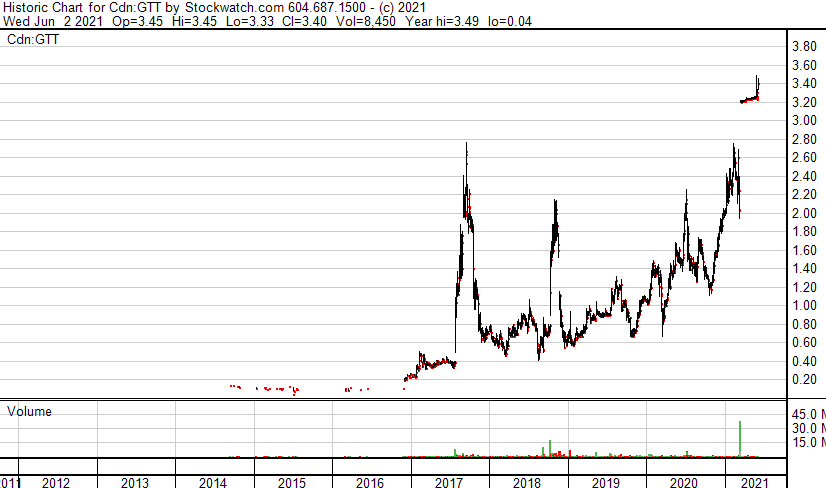
GT Gold’s outcome does not guarantee Oreterra’s. But it is a useful reminder of what the path can look like, even for a company that eventually gets acquired.
Where I stand on Oreterra
My thesis remains a long-term hold for potential multibagger upside if Trek South delivers. That is a possibility, not an outcome the drilling has established. Once assays are released, the stock could pull back on the results or as the news flow slows through winter ahead of the next drilling season. Even encouraging assays would not rule out a dip during that wait. The results need to keep supporting the thesis, and patience alone will not turn weak geology into a discovery.
The share-price performance has been frustrating. But these conversations have given me a much more understandable explanation for at least part of the selling pressure. The legacy paper existed. Some former directors sold. An estate sold. Financing participants had shares and warrants that could make selling attractive. Meanwhile, Drivas remained supportive and invested more, and Kevin confirmed that Burega and Biczok have not sold. Ashley directly confirmed she has not sold either. I am less inclined to read this pullback as management losing confidence in Trek South. At the same time, I am not giving the geology a free pass because management sounds confident. CEOs naturally emphasize the positives. The assays need to give us enough encouragement to keep the thesis alive, and the bigger test comes next summer when Oreterra attempts to drill the interpreted root.
On the surface, it looks cheap to me. For further purchases, I need assays that warrant putting more money into it. Keep in mind that junior mining stocks can make fortunes, but they can also cut in half while you wait. Sometimes both happen in the same stock. That is why I continue to view these investments over a multi-year timeframe. Buy in tranches. Add when the company proves it deserves more of your money. And keep checking whether the evidence still supports the reason you bought it.